Checking The Air Induction System
Fragment manuala — str. 466
📋 Tekst do skopiowania / wyszukiwania
AIR INDUCTION SYSTEM

EAS27050
                                                             1. Check:
CHECKING THE PRESSURE REGULATOR
                                                              • Hoses
1. Check:
                                                                Loose connections → Connect properly.
 • Pressure regulator
                                                                Cracks/damage → Replace.
   Damage → Replace.
                                                              • Pipes
EAS27060                                                        Cracks/damage → Replace.
CHECKING THE AIR INDUCTION SYSTEM                            2. Check:
                                                              • Reed valve
Air injection                                                 • Reed valve stopper
The air induction system burns unburned ex-                   • Reed valve seat
haust gases by injecting fresh air (secondary air)              Cracks/damage → Replace the reed valve.
into the exhaust port, reducing the emission of              3. Check:
hydrocarbons. When there is negative pressure                 • Air cut-off valve
at the exhaust port, the reed valve opens, allow-               Cracks/damage → Replace.
ing secondary air to flow into the exhaust port.             4. Check:
The required temperature for burning the un-                  • Air induction system solenoid
burned exhaust gases is approximately 600 to                    Refer to “CHECKING THE AIR INDUCTION
700 °C (1112 to 1292 °F).                                       SYSTEM SOLENOID” on page 8-232.

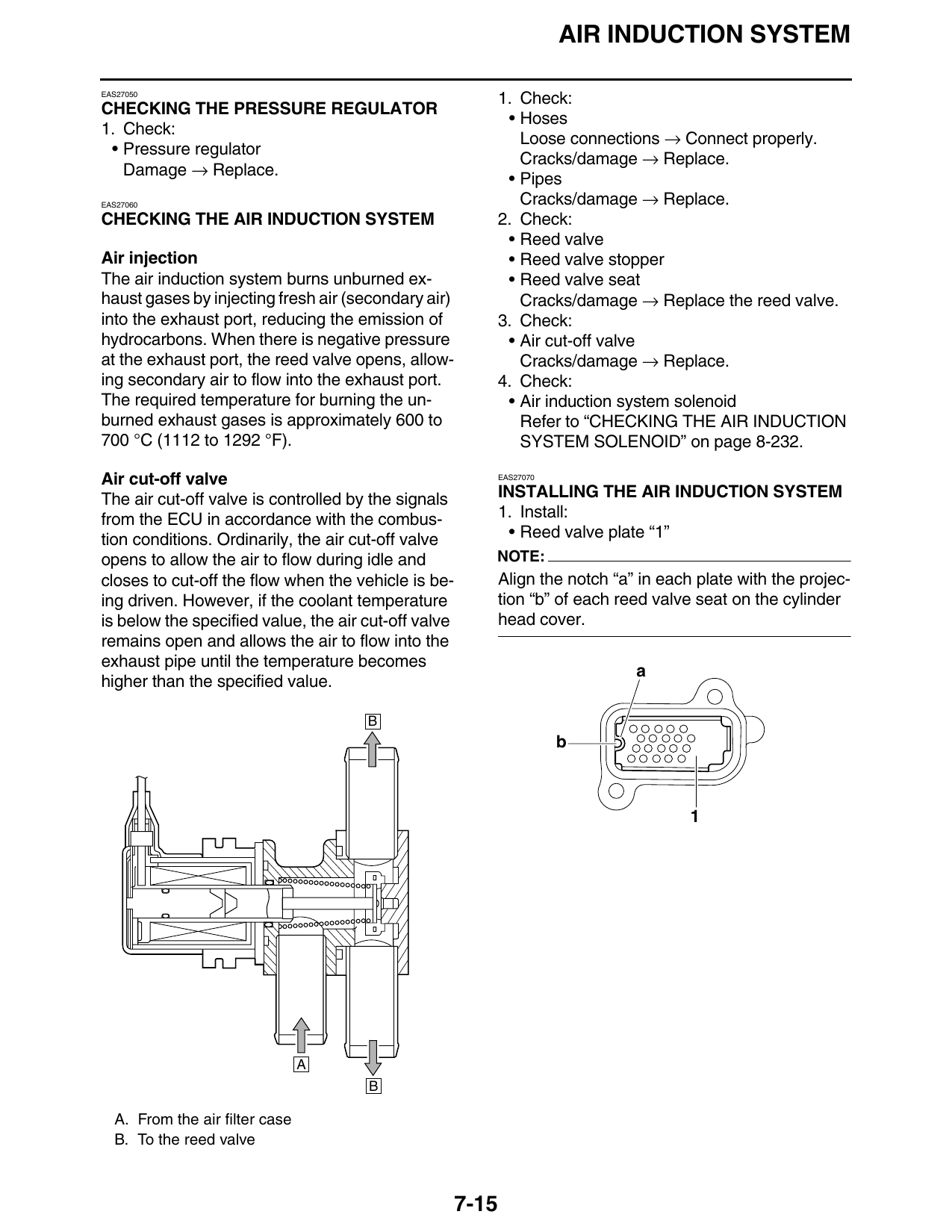
Air cut-off valve                                            EAS27070

The air cut-off valve is controlled by the signals           INSTALLING THE AIR INDUCTION SYSTEM
from the ECU in accordance with the combus-                  1. Install:
tion conditions. Ordinarily, the air cut-off valve             • Reed valve plate “1”
opens to allow the air to flow during idle and           NOTE:
closes to cut-off the flow when the vehicle is be-           Align the notch “a” in each plate with the projec-
ing driven. However, if the coolant temperature              tion “b” of each reed valve seat on the cylinder
is below the specified value, the air cut-off valve          head cover.
remains open and allows the air to flow into the
exhaust pipe until the temperature becomes
                                                                                a
higher than the specified value.

                                      B
                                                                        b

                                A
                                      B

  A. From the air filter case
  B. To the reed valve

                                                      7-15