ABS Operation
Fragment manuala — str. 25–28
📋 Tekst do skopiowania / wyszukiwania
FEATURES

            1                 10

                     4                                              14

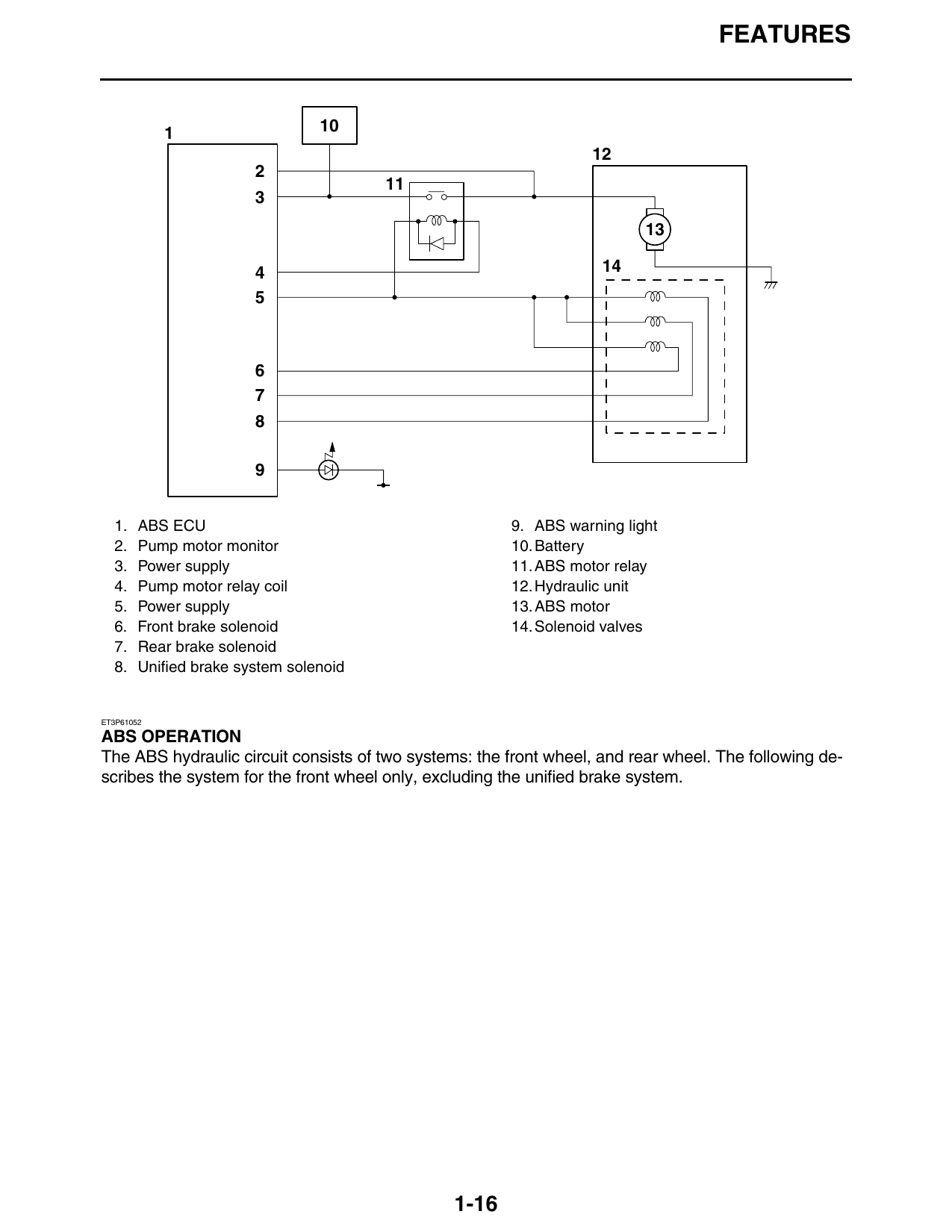
  1. ABS ECU                                           9. ABS warning light
  2. Pump motor monitor                                10. Battery
  3. Power supply                                      11. ABS motor relay
  4. Pump motor relay coil                             12. Hydraulic unit
  5. Power supply                                      13. ABS motor
  6. Front brake solenoid                              14. Solenoid valves
  7. Rear brake solenoid
  8. Unified brake system solenoid

ET3P61052

ABS OPERATION
The ABS hydraulic circuit consists of two systems: the front wheel, and rear wheel. The following de-
scribes the system for the front wheel only, excluding the unified brake system.

                                                1-16
                                                                                       FEATURES

Normal braking (ABS not activated)
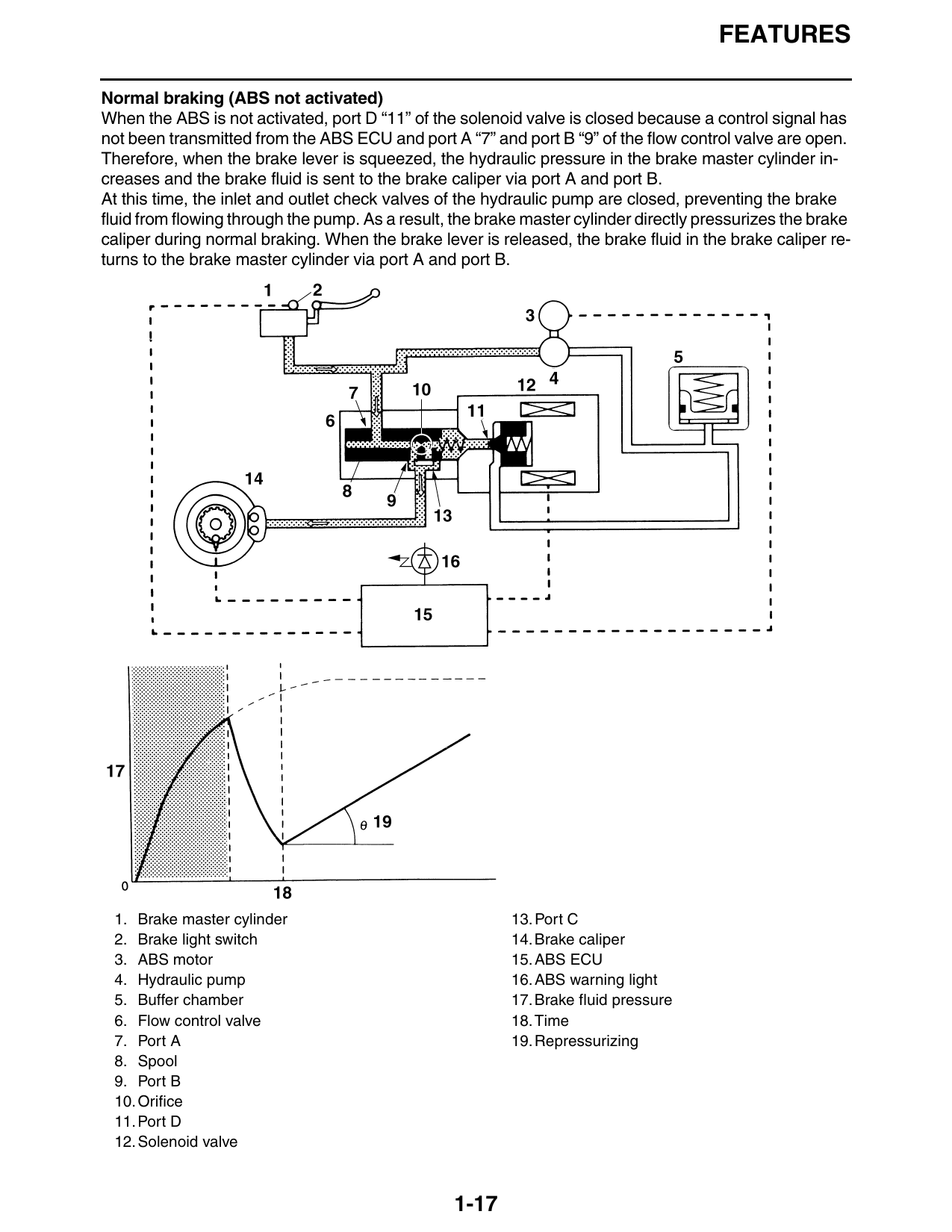
When the ABS is not activated, port D “11” of the solenoid valve is closed because a control signal has
not been transmitted from the ABS ECU and port A “7” and port B “9” of the flow control valve are open.
Therefore, when the brake lever is squeezed, the hydraulic pressure in the brake master cylinder in-
creases and the brake fluid is sent to the brake caliper via port A and port B.
At this time, the inlet and outlet check valves of the hydraulic pump are closed, preventing the brake
fluid from flowing through the pump. As a result, the brake master cylinder directly pressurizes the brake
caliper during normal braking. When the brake lever is released, the brake fluid in the brake caliper re-
turns to the brake master cylinder via port A and port B.

 1. Brake master cylinder                                13. Port C
 2. Brake light switch                                   14. Brake caliper
 3. ABS motor                                            15. ABS ECU
 4. Hydraulic pump                                       16. ABS warning light
 5. Buffer chamber                                       17. Brake fluid pressure
 6. Flow control valve                                   18. Time
 7. Port A                                               19. Repressurizing
 8. Spool
 9. Port B
 10. Orifice
 11. Port D
 12. Solenoid valve

                                                 1-17
                                                                                        FEATURES

Emergency braking (ABS activated)
1. Depressurized state
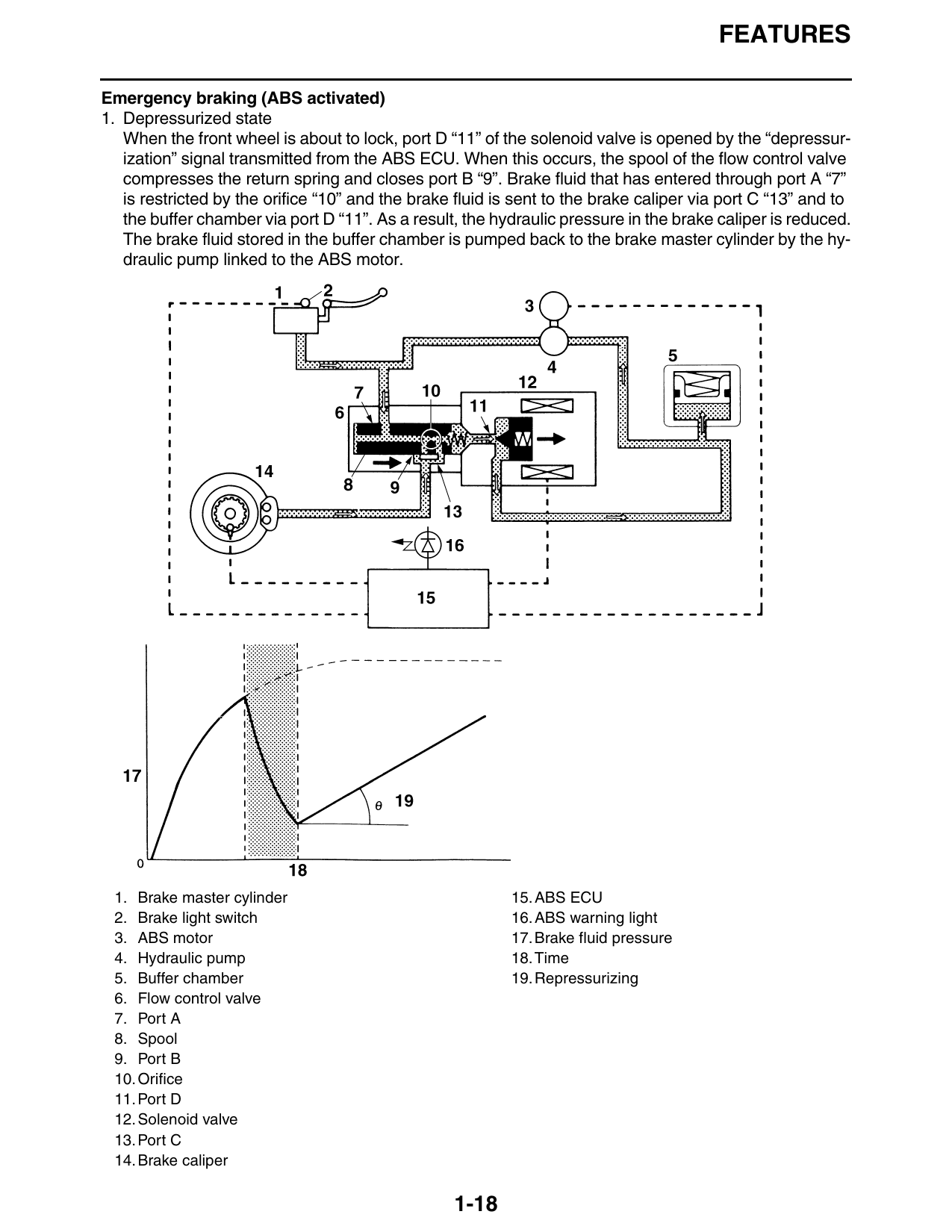
   When the front wheel is about to lock, port D “11” of the solenoid valve is opened by the “depressur-
   ization” signal transmitted from the ABS ECU. When this occurs, the spool of the flow control valve
   compresses the return spring and closes port B “9”. Brake fluid that has entered through port A “7”
   is restricted by the orifice “10” and the brake fluid is sent to the brake caliper via port C “13” and to
   the buffer chamber via port D “11”. As a result, the hydraulic pressure in the brake caliper is reduced.
   The brake fluid stored in the buffer chamber is pumped back to the brake master cylinder by the hy-
   draulic pump linked to the ABS motor.

 1. Brake master cylinder                                  15. ABS ECU
 2. Brake light switch                                     16. ABS warning light
 3. ABS motor                                              17. Brake fluid pressure
 4. Hydraulic pump                                         18. Time
 5. Buffer chamber                                         19. Repressurizing
 6. Flow control valve
 7. Port A
 8. Spool
 9. Port B
 10. Orifice
 11. Port D
 12. Solenoid valve
 13. Port C
 14. Brake caliper

                                                  1-18
                                                                                         FEATURES

2. Pressurized state
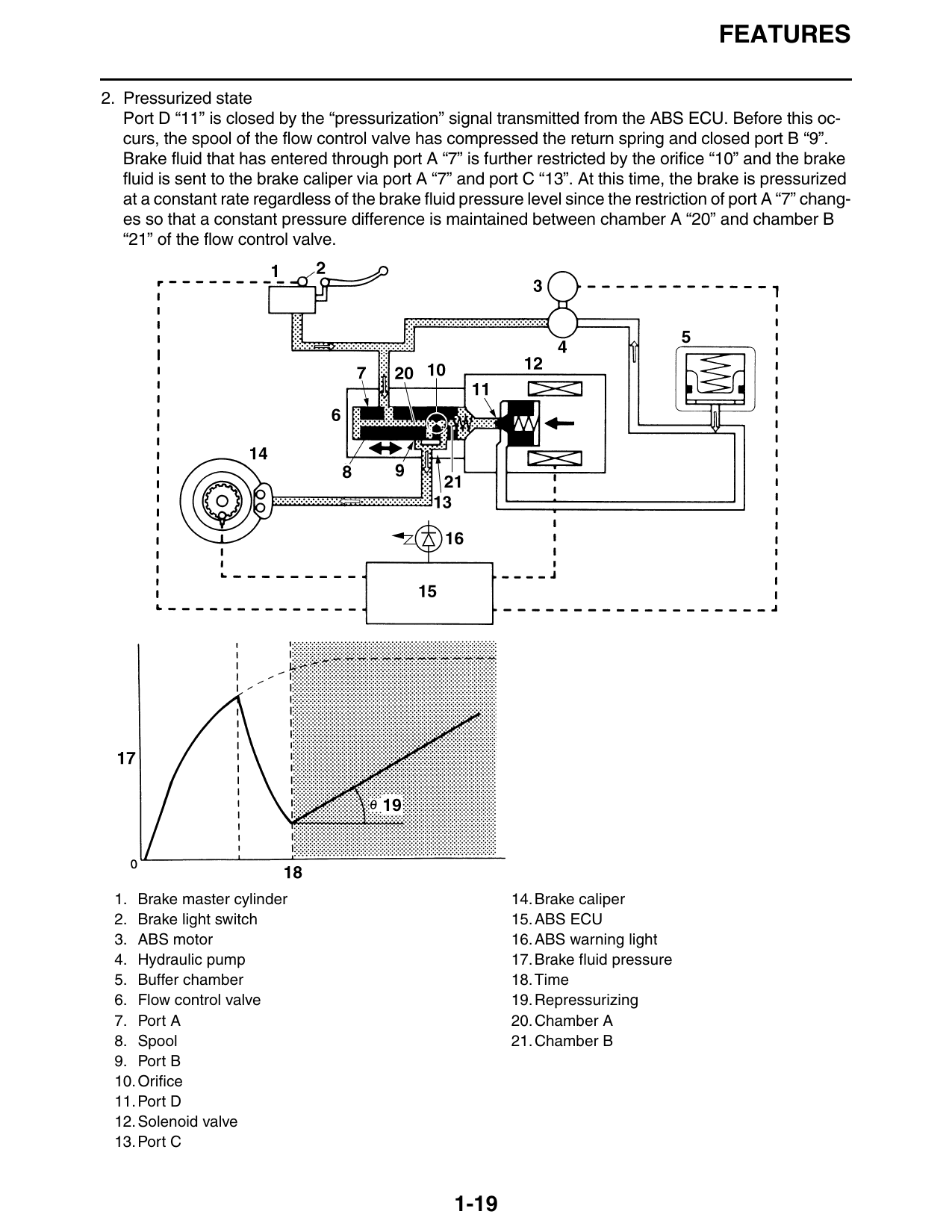
   Port D “11” is closed by the “pressurization” signal transmitted from the ABS ECU. Before this oc-
   curs, the spool of the flow control valve has compressed the return spring and closed port B “9”.
   Brake fluid that has entered through port A “7” is further restricted by the orifice “10” and the brake
   fluid is sent to the brake caliper via port A “7” and port C “13”. At this time, the brake is pressurized
   at a constant rate regardless of the brake fluid pressure level since the restriction of port A “7” chang-
   es so that a constant pressure difference is maintained between chamber A “20” and chamber B
   “21” of the flow control valve.

 1. Brake master cylinder                                  14. Brake caliper
 2. Brake light switch                                     15. ABS ECU
 3. ABS motor                                              16. ABS warning light
 4. Hydraulic pump                                         17. Brake fluid pressure
 5. Buffer chamber                                         18. Time
 6. Flow control valve                                     19. Repressurizing
 7. Port A                                                 20. Chamber A
 8. Spool                                                  21. Chamber B
 9. Port B
 10. Orifice
 11. Port D
 12. Solenoid valve
 13. Port C

                                                   1-19