Outline Of The YCC-S (Yamaha Chip Controlled-Shift) System (FJR13AE)
Fragment manuala — str. 32–34
📋 Tekst do skopiowania / wyszukiwania
FEATURES

• Depending on the road conditions, the braking distance may be longer compared to that of vehicles
  not equipped with ABS. Therefore, ride at a safe speed and keep a safe distance between yourself
  and other vehicles.
• The braking of the vehicle, even in the worst case, is principally executed when the vehicle is advanc-
  ing straight ahead. During a turn, sudden braking is liable to cause a loss of traction of the tires. Even
  vehicles equipped with ABS cannot be prevented from falling over if braked suddenly.
• The ABS does not work when the main switch is turned to “OFF”. The conventional braking function
  can be used.
* Wheel lock: A condition that occurs when the rotation of one or both of the wheels has stopped, but
the vehicle continues to travel.
ET3P66049

OUTLINE OF THE YCC-S (Yamaha Chip Controlled-Shift) SYSTEM (FJR13AE)

Concept
YCC-S offers more enjoyable and easy riding by eliminating the need for the user to operate the clutch,
which also reduces fatigue during long touring.
YCC-S is not an automatic transmission, although it allows the user to shift gears by foot or hand ac-
cording to preference.
When shifting, a signal is sent to the MCU (motor control unit), which ensures optimum clutch operation,
shifting, and engine control. Therefore, the user never needs to operate the clutch, which in turn, reduc-
es fatigue and allows the user to concentrate while riding.
When stopping at traffic lights or in traffic jams, YCC-S operates the clutch instead of the user.

Basic function
To shift gears after starting the engine, the user must use the shift pedal. However, depending on the
user’s preference, the transmission can be shifted by hand after setting the hand shift select button to
“ON”.
When the engine is started, the MCU disengages the clutch. A signal is sent to the MCU when the trans-
mission is shifted from neutral to 1st gear by hand or foot. When the throttle is opened, the MCU then
engages the clutch according to engine r/min. Clutch engagement is controlled optimally by the MCU.
Clutch engagement is not constant in order to provide smooth shifting according to engine require-
ments and conditions.
The YCC-S system will not shift up if the engine r/min is lower than a specified value. Even if the user
shifts up, if the specified value is not met (engine r/min is too low), the YCC-S system will not shift up
until the above-mentioned specified value is met.
Likewise, the YCC-S system will not shift down if the specified value is not met (engine r/min is too
high).
In this case, the throttle must be closed so that the MCU can disengage the clutch until the specified
value is met to prevent the engine from stopping. During this period, a coasting condition will be felt.
The user must shift down properly in order for the YCC-S system to provide a smooth stopping condi-
tion.
The YCC-S system is constantly performing a self-diagnosis when the engine is running. If any trouble
is detected, the MCU automatically stops the YCC-S system and shifting is impossible.

                                                  1-23
                                                                                          FEATURES

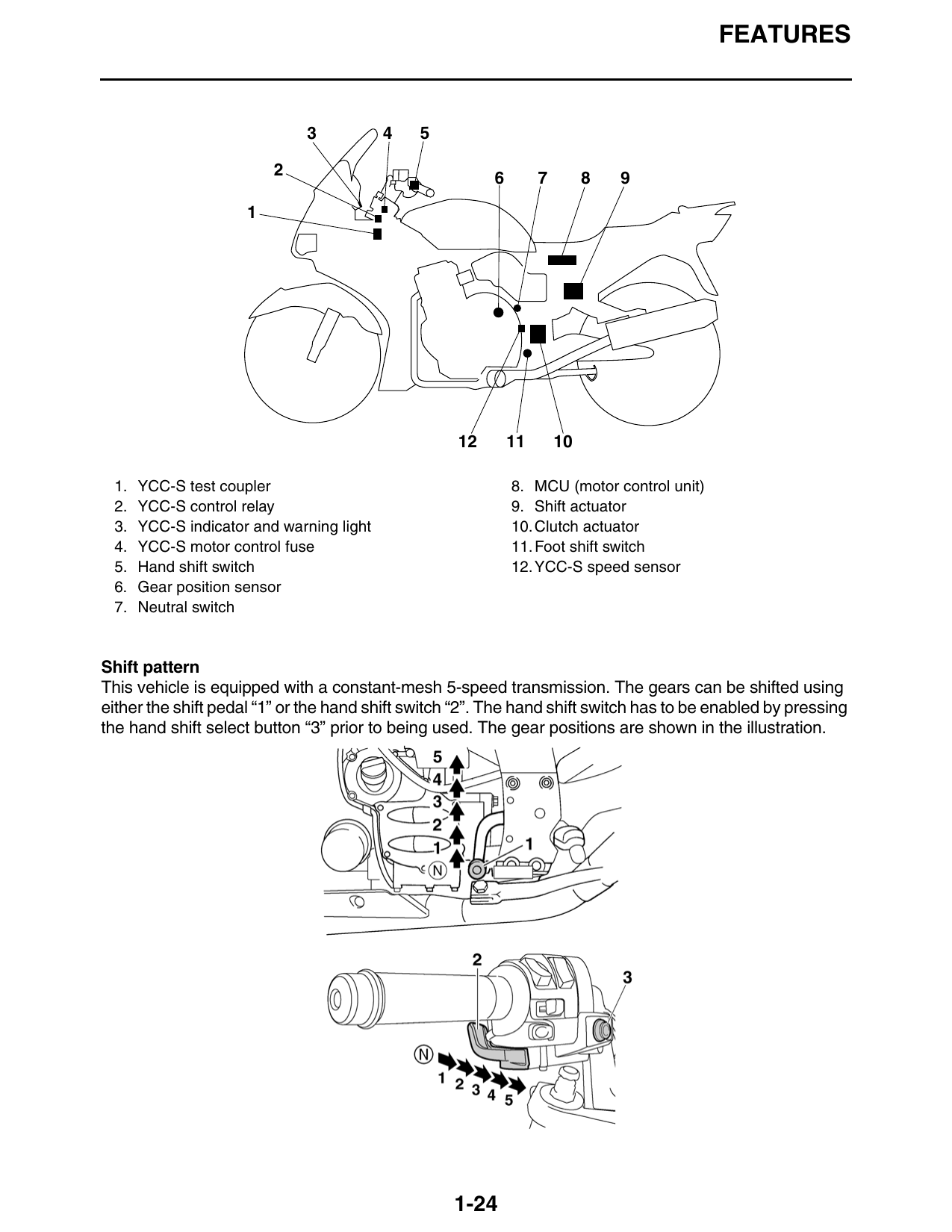
                             3          4     5

                         2                              6        7        8   9

                                                   12       11       10

 1. YCC-S test coupler                                      8. MCU (motor control unit)
 2. YCC-S control relay                                     9. Shift actuator
 3. YCC-S indicator and warning light                       10. Clutch actuator
 4. YCC-S motor control fuse                                11. Foot shift switch
 5. Hand shift switch                                       12. YCC-S speed sensor
 6. Gear position sensor
 7. Neutral switch

Shift pattern
This vehicle is equipped with a constant-mesh 5-speed transmission. The gears can be shifted using
either the shift pedal “1” or the hand shift switch “2”. The hand shift switch has to be enabled by pressing
the hand shift select button “3” prior to being used. The gear positions are shown in the illustration.

                                                   1-24
                                                                                        FEATURES

Attention
• Do not turn the main switch to “OFF” while the vehicle is moving, otherwise the electrical systems will
  be switched off, including the YCC-S system, which may result in loss of control or an accident. Make
  sure that the vehicle is stopped before turning the main switch to “OFF”.
• The clutch will be engaged for a few seconds after the engine is stopped using the main switch if the
  transmission is not in neutral. This means that the vehicle cannot be moved by pushing or pulling it.
  To move the vehicle, turn the main switch to “ON”, and then apply the front or rear brake to disengage
  the clutch. A click will be heard when the clutch is disengaged.
• Always stop the engine and turn the main switch to “LOCK” when parking the vehicle.

YCC-S indicator and warning light
• The YCC-S system is constantly performing a self-diagnosis.
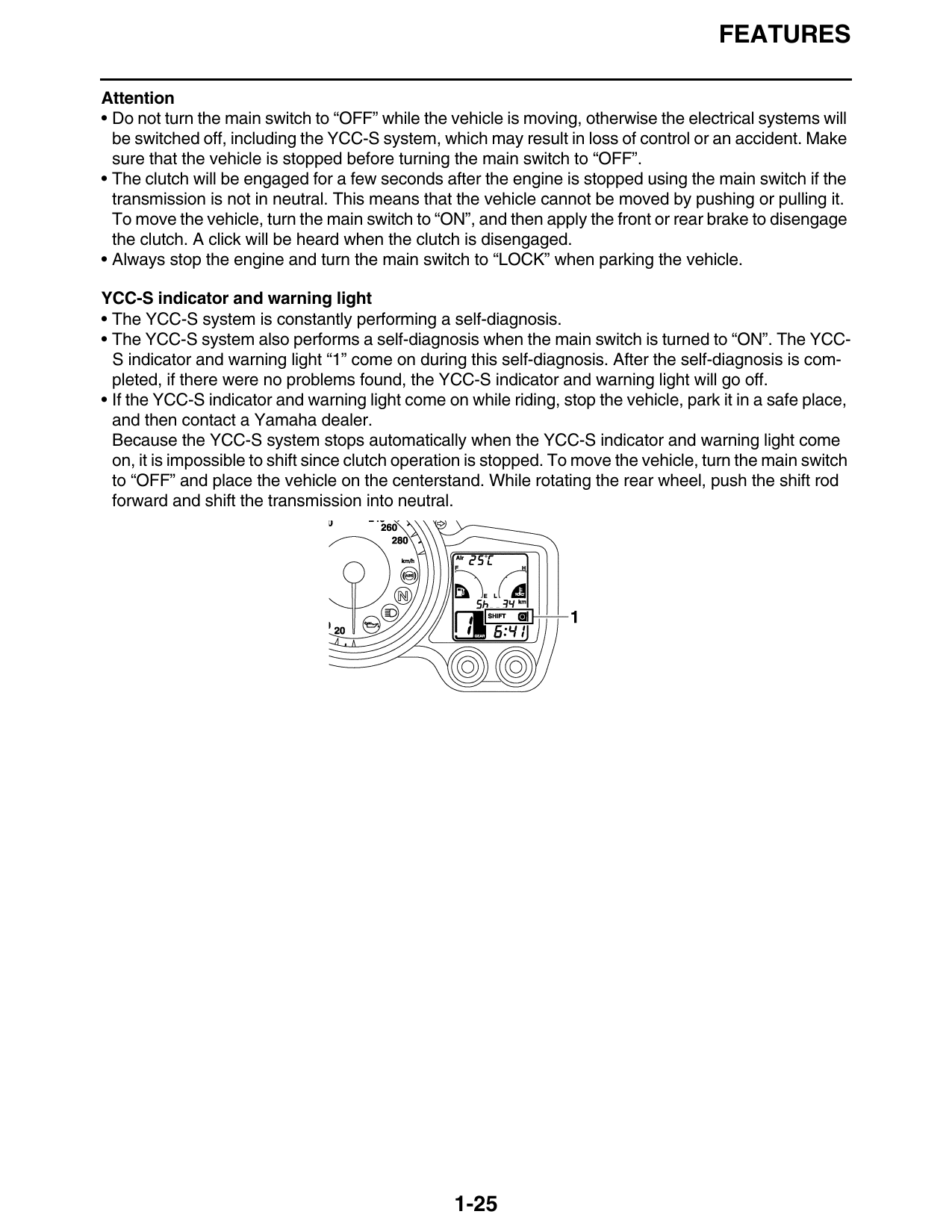
• The YCC-S system also performs a self-diagnosis when the main switch is turned to “ON”. The YCC-
  S indicator and warning light “1” come on during this self-diagnosis. After the self-diagnosis is com-
  pleted, if there were no problems found, the YCC-S indicator and warning light will go off.
• If the YCC-S indicator and warning light come on while riding, stop the vehicle, park it in a safe place,
  and then contact a Yamaha dealer.
  Because the YCC-S system stops automatically when the YCC-S indicator and warning light come
  on, it is impossible to shift since clutch operation is stopped. To move the vehicle, turn the main switch
  to “OFF” and place the vehicle on the centerstand. While rotating the rear wheel, push the shift rod
  forward and shift the transmission into neutral.

                                                  1-25