Hydraulic Unit Operation Tests
Fragment manuala — str. 247–249
📋 Tekst do skopiowania / wyszukiwania
ABS (ANTI-LOCK BRAKE SYSTEM)

5. Fill:                                                   The hydraulic unit operation can be tested using
 • Brake master cylinder reservoir                         the following two methods.
 • Brake fluid reservoir                                   • Hydraulic unit operation test 1: this test checks
   (with the specified amount of the recom-                  the function of the ABS after the system was
   mended brake fluid)                                       disassembled, adjusted, or serviced.
                                                           • Hydraulic unit operation test 2: this test gener-
           Recommended fluid                                 ates the same reaction-force pulsating action
            DOT 4                                            that is generated in the brake lever and brake
EWA13090
                                                             pedal when the ABS is activated.
       WARNING
                                                           Hydraulic unit operation test 1
• Use only the designated brake fluid. Other               EWA13120

  brake fluids may cause the rubber seals to                     WARNING
  deteriorate, causing leakage and poor                    Securely support the vehicle so that there is
  brake performance.                                       no danger of it falling over.
• Refill with the same type of brake fluid that
  is already in the system. Mixing brake fluids        NOTE:
  may result in a harmful chemical reaction,               Two people are necessary to perform hydraulic
  leading to poor brake performance.                       unit operation test 1.
• When refilling, be careful that water does
  not enter the brake fluid reservoir. Water               1. Place the vehicle on the centerstand.
  will significantly lower the boiling point of            2. Turn the main switch to “OFF”.
  the brake fluid and could cause vapor lock.              3. Remove:
                                                            • Front cowling right inner panel 1
ECA13540
                                                              Refer to “GENERAL CHASSIS” on page 4-1.
CAUTION:
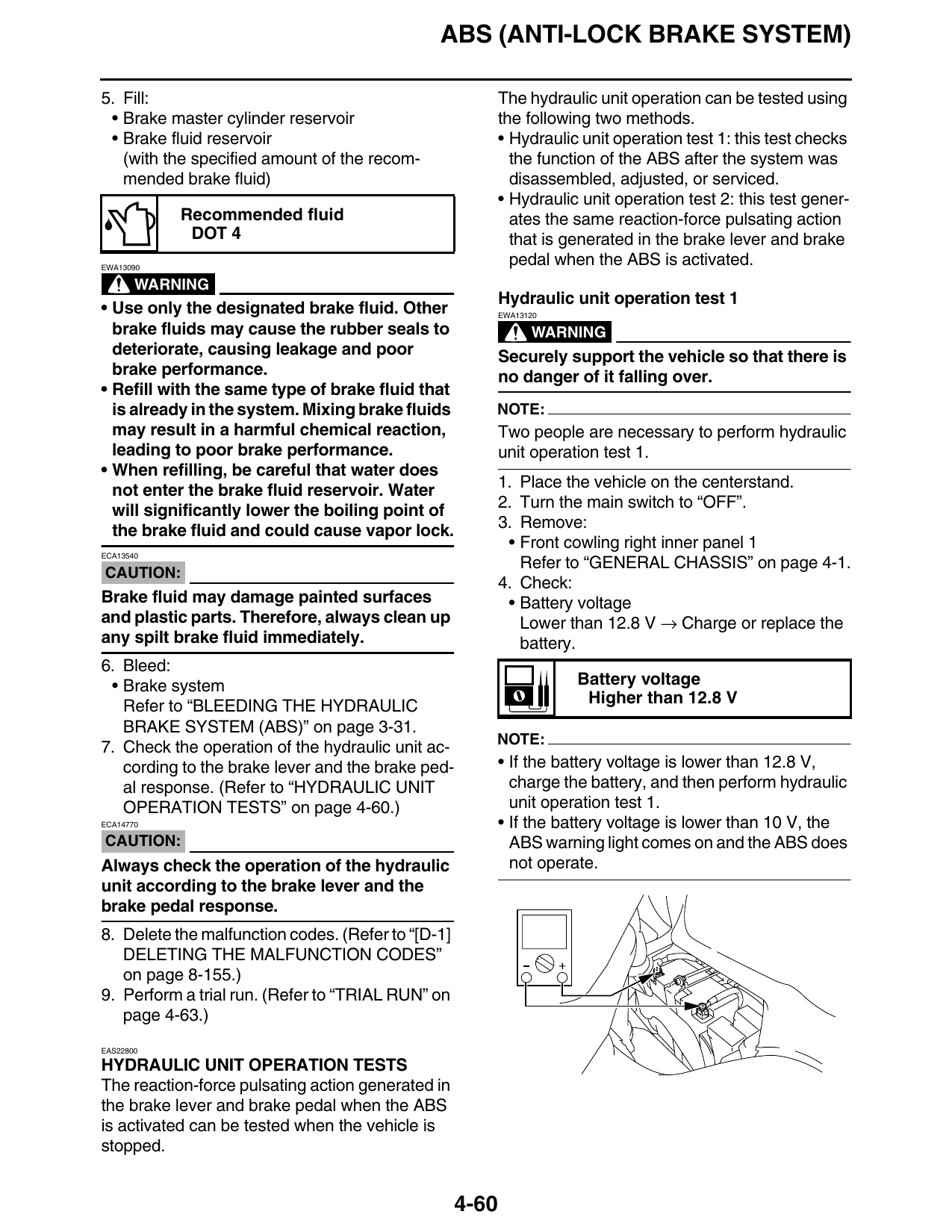
                                                           4. Check:
Brake fluid may damage painted surfaces                     • Battery voltage
and plastic parts. Therefore, always clean up                 Lower than 12.8 V → Charge or replace the
any spilt brake fluid immediately.                            battery.
6. Bleed:
 • Brake system                                                       Battery voltage
   Refer to “BLEEDING THE HYDRAULIC                                    Higher than 12.8 V
   BRAKE SYSTEM (ABS)” on page 3-31.
                                                       NOTE:
7. Check the operation of the hydraulic unit ac-
   cording to the brake lever and the brake ped-           • If the battery voltage is lower than 12.8 V,
   al response. (Refer to “HYDRAULIC UNIT                    charge the battery, and then perform hydraulic
   OPERATION TESTS” on page 4-60.)                           unit operation test 1.
ECA14770                                                   • If the battery voltage is lower than 10 V, the
CAUTION:                                                     ABS warning light comes on and the ABS does
Always check the operation of the hydraulic                  not operate.
unit according to the brake lever and the
brake pedal response.
8. Delete the malfunction codes. (Refer to “[D-1]
   DELETING THE MALFUNCTION CODES”
   on page 8-155.)
9. Perform a trial run. (Refer to “TRIAL RUN” on
   page 4-63.)
EAS22800

HYDRAULIC UNIT OPERATION TESTS
The reaction-force pulsating action generated in
the brake lever and brake pedal when the ABS
is activated can be tested when the vehicle is
stopped.

                                                    4-60
                                                  ABS (ANTI-LOCK BRAKE SYSTEM)

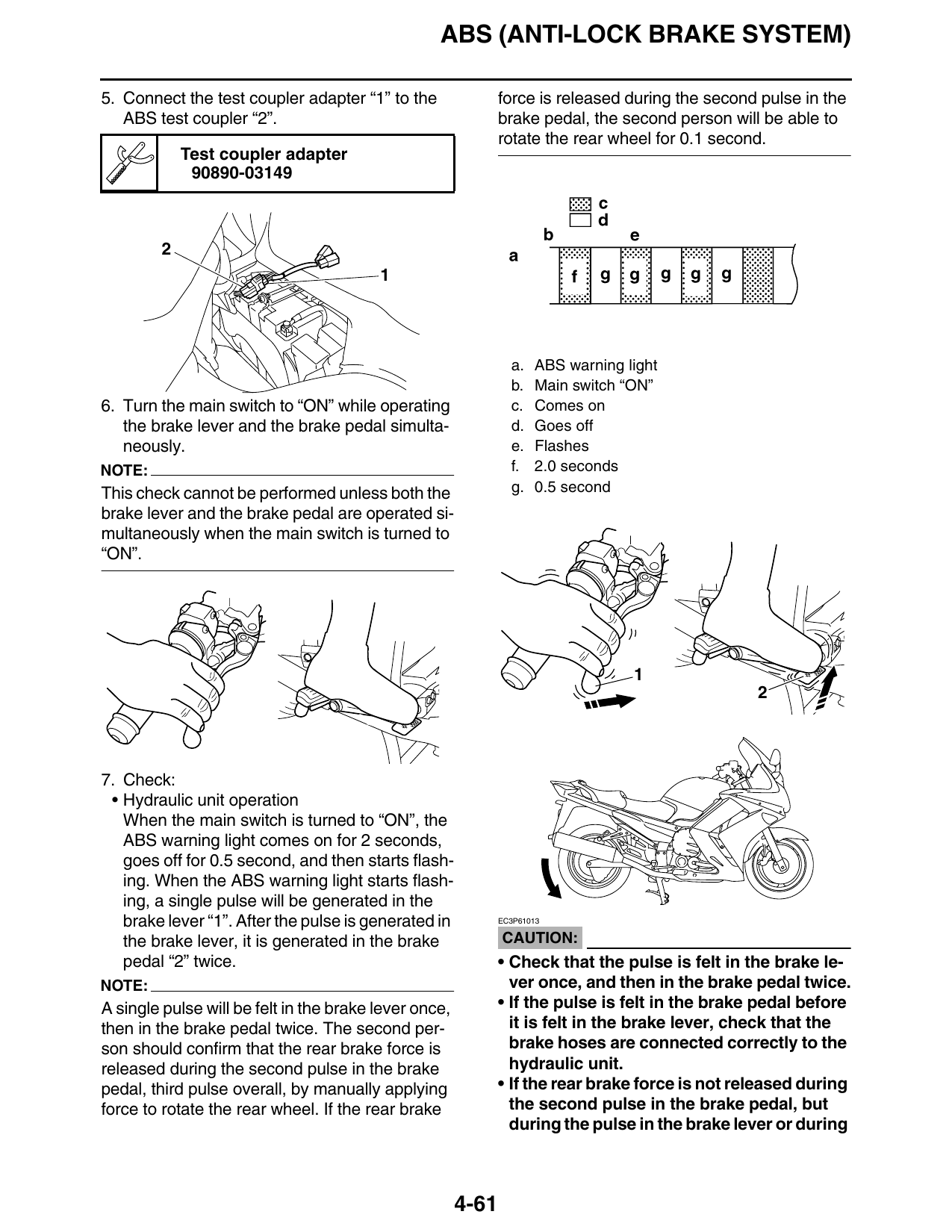
5. Connect the test coupler adapter “1” to the                force is released during the second pulse in the
   ABS test coupler “2”.                                      brake pedal, the second person will be able to
                                                              rotate the rear wheel for 0.1 second.
             Test coupler adapter
              90890-03149

                                                                a. ABS warning light
                                                                b. Main switch “ON”
6. Turn the main switch to “ON” while operating                 c. Comes on
   the brake lever and the brake pedal simulta-                 d. Goes off
   neously.                                                     e. Flashes
NOTE:                                                           f. 2.0 seconds
This check cannot be performed unless both the                  g. 0.5 second
brake lever and the brake pedal are operated si-
multaneously when the main switch is turned to
“ON”.

7. Check:
 • Hydraulic unit operation
   When the main switch is turned to “ON”, the
   ABS warning light comes on for 2 seconds,
   goes off for 0.5 second, and then starts flash-
   ing. When the ABS warning light starts flash-
   ing, a single pulse will be generated in the
   brake lever “1”. After the pulse is generated in           EC3P61013

   the brake lever, it is generated in the brake              CAUTION:
   pedal “2” twice.                                           • Check that the pulse is felt in the brake le-
NOTE:                                                           ver once, and then in the brake pedal twice.
A single pulse will be felt in the brake lever once,          • If the pulse is felt in the brake pedal before
then in the brake pedal twice. The second per-                  it is felt in the brake lever, check that the
son should confirm that the rear brake force is                 brake hoses are connected correctly to the
released during the second pulse in the brake                   hydraulic unit.
pedal, third pulse overall, by manually applying              • If the rear brake force is not released during
force to rotate the rear wheel. If the rear brake               the second pulse in the brake pedal, but
                                                                during the pulse in the brake lever or during

                                                       4-61
                                                   ABS (ANTI-LOCK BRAKE SYSTEM)

  the first pulse in the brake pedal, check that
  the brake hoses are connected correctly to
  the hydraulic unit.                                                     2
• If the pulse is hardly felt in either the brake                                                       1
  lever or brake pedal, check that the brake
  hoses are connected correctly to the hy-
  draulic unit.
  • If the operation of the hydraulic unit is normal,
    delete all of the malfunction codes.
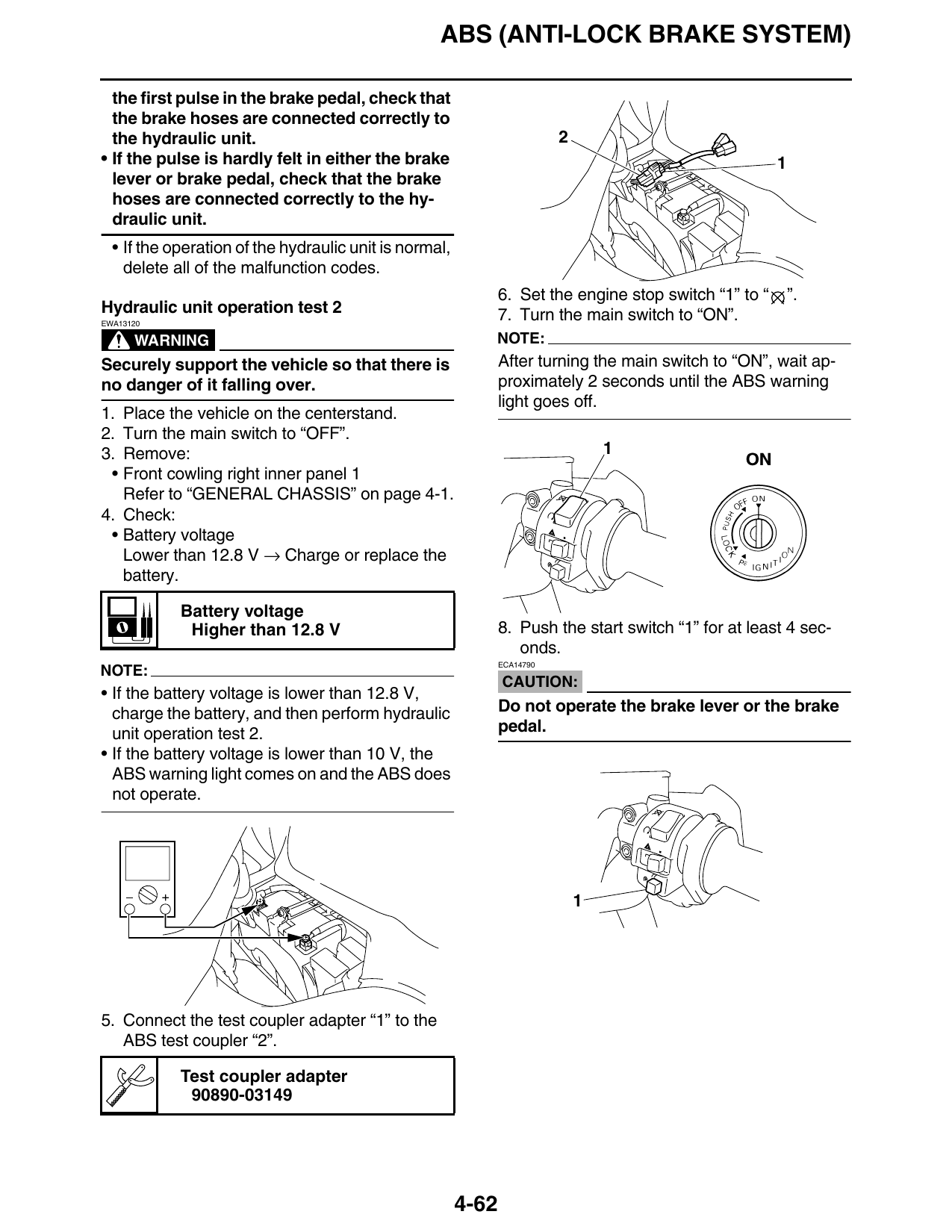
                                                               6. Set the engine stop switch “1” to “       ”.
Hydraulic unit operation test 2                                7. Turn the main switch to “ON”.
EWA13120

      WARNING                                              NOTE:
Securely support the vehicle so that there is                  After turning the main switch to “ON”, wait ap-
no danger of it falling over.                                  proximately 2 seconds until the ABS warning
                                                               light goes off.
1. Place the vehicle on the centerstand.
2. Turn the main switch to “OFF”.
3. Remove:                                                                        1
 • Front cowling right inner panel 1
   Refer to “GENERAL CHASSIS” on page 4-1.
4. Check:
 • Battery voltage
   Lower than 12.8 V → Charge or replace the
   battery.

            Battery voltage
             Higher than 12.8 V                                8. Push the start switch “1” for at least 4 sec-
                                                                  onds.
                                                               ECA14790
NOTE:
                                                               CAUTION:
• If the battery voltage is lower than 12.8 V,
  charge the battery, and then perform hydraulic               Do not operate the brake lever or the brake
  unit operation test 2.                                       pedal.
• If the battery voltage is lower than 10 V, the
  ABS warning light comes on and the ABS does
  not operate.

5. Connect the test coupler adapter “1” to the
   ABS test coupler “2”.

            Test coupler adapter
             90890-03149

                                                        4-62