Installing The Front Brake Master Cylinder
Fragment manuala — str. 226–227
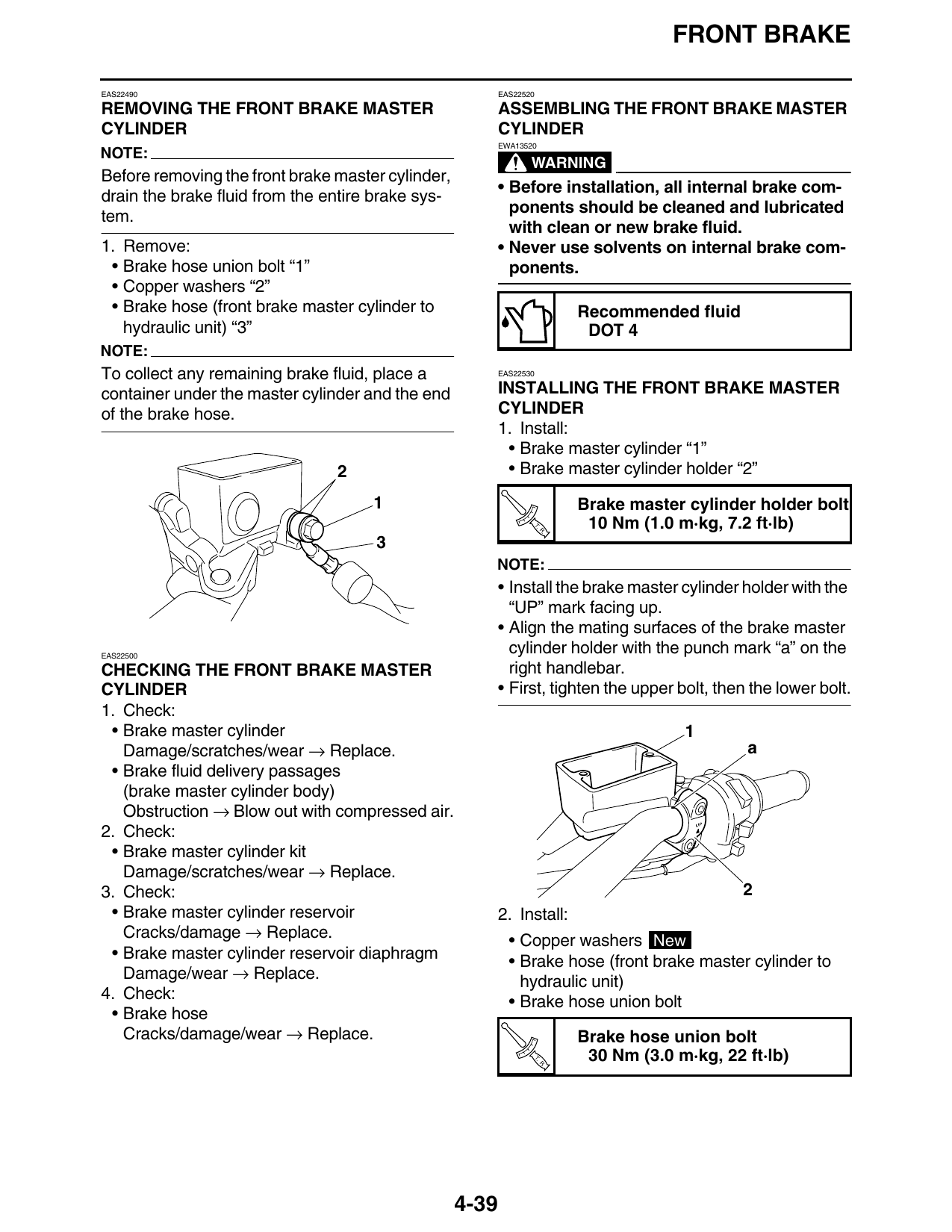
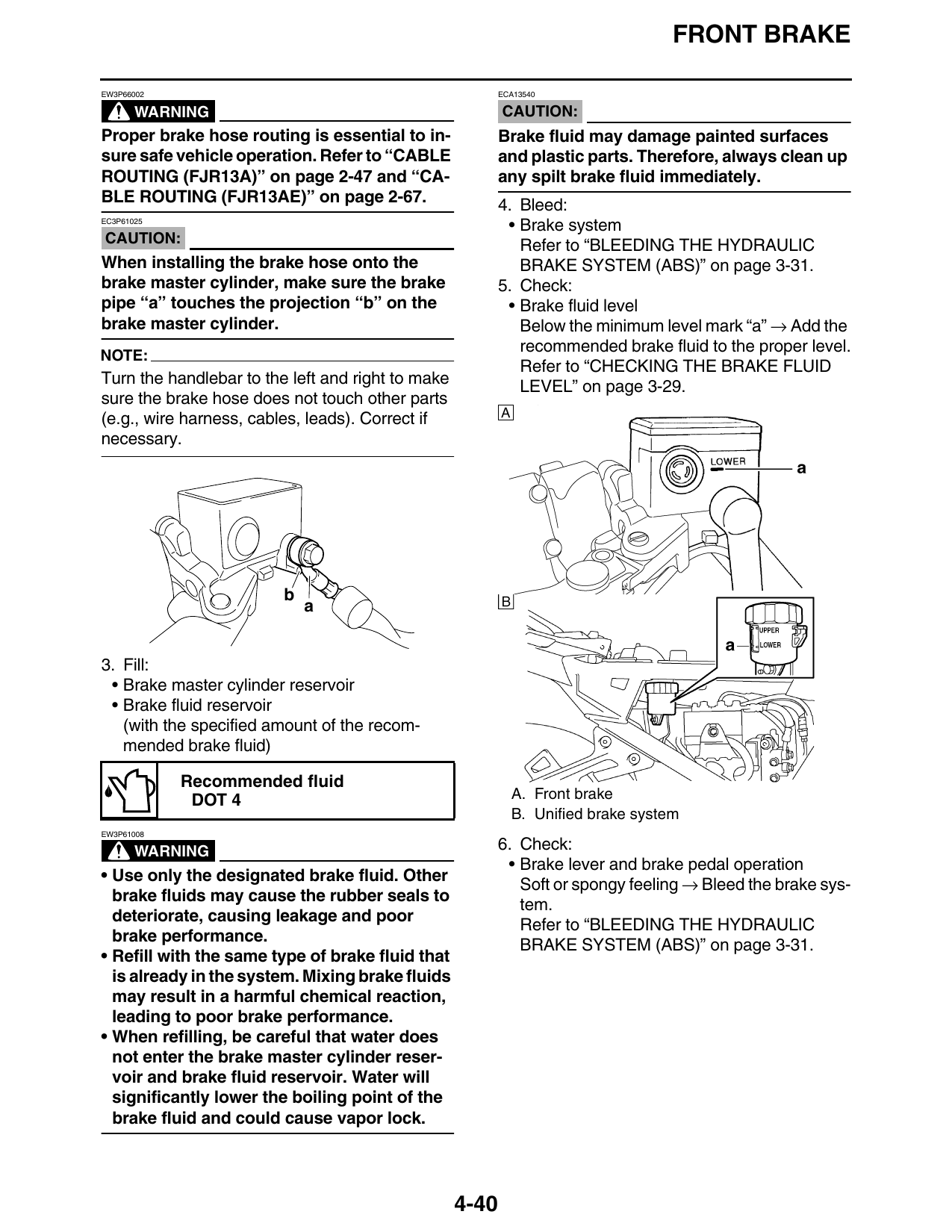
📋 Tekst do skopiowania / wyszukiwania
FRONT BRAKE

EAS22490                                                  EAS22520

REMOVING THE FRONT BRAKE MASTER                           ASSEMBLING THE FRONT BRAKE MASTER
CYLINDER                                                  CYLINDER
                                                          EWA13520
NOTE:
                                                                 WARNING
Before removing the front brake master cylinder,
                                                          • Before installation, all internal brake com-
drain the brake fluid from the entire brake sys-
                                                            ponents should be cleaned and lubricated
tem.
                                                            with clean or new brake fluid.
1. Remove:                                                • Never use solvents on internal brake com-
 • Brake hose union bolt “1”                                ponents.
 • Copper washers “2”
 • Brake hose (front brake master cylinder to                             Recommended fluid
   hydraulic unit) “3”                                                     DOT 4
NOTE:
To collect any remaining brake fluid, place a             EAS22530

container under the master cylinder and the end           INSTALLING THE FRONT BRAKE MASTER
of the brake hose.                                        CYLINDER
                                                          1. Install:
                                                            • Brake master cylinder “1”
                                2                           • Brake master cylinder holder “2”
                                     1                                    Brake master cylinder holder bolt
                                                                 T.
                                                                     R.
                                                                           10 Nm (1.0 m·kg, 7.2 ft·lb)
                                                      NOTE:
                                                          • Install the brake master cylinder holder with the
                                                            “UP” mark facing up.
                                                          • Align the mating surfaces of the brake master
EAS22500
                                                            cylinder holder with the punch mark “a” on the
CHECKING THE FRONT BRAKE MASTER                             right handlebar.
CYLINDER                                                  • First, tighten the upper bolt, then the lower bolt.
1. Check:
 • Brake master cylinder                                                               1
   Damage/scratches/wear → Replace.                                                            a
 • Brake fluid delivery passages
   (brake master cylinder body)
   Obstruction → Blow out with compressed air.
2. Check:
 • Brake master cylinder kit
   Damage/scratches/wear → Replace.
3. Check:                                                                                      2
 • Brake master cylinder reservoir                        2. Install:
   Cracks/damage → Replace.                                 • Copper washers New
 • Brake master cylinder reservoir diaphragm                • Brake hose (front brake master cylinder to
   Damage/wear → Replace.                                     hydraulic unit)
4. Check:                                                   • Brake hose union bolt
 • Brake hose
   Cracks/damage/wear → Replace.                                          Brake hose union bolt
                                                                 T.
                                                                     R.
                                                                           30 Nm (3.0 m·kg, 22 ft·lb)

                                                   4-39
                                                                                  FRONT BRAKE

EW3P66002                                                 ECA13540

       WARNING                                            CAUTION:
Proper brake hose routing is essential to in-             Brake fluid may damage painted surfaces
sure safe vehicle operation. Refer to “CABLE              and plastic parts. Therefore, always clean up
ROUTING (FJR13A)” on page 2-47 and “CA-                   any spilt brake fluid immediately.
BLE ROUTING (FJR13AE)” on page 2-67.                      4. Bleed:
EC3P61025
                                                           • Brake system
CAUTION:                                                     Refer to “BLEEDING THE HYDRAULIC
When installing the brake hose onto the                      BRAKE SYSTEM (ABS)” on page 3-31.
brake master cylinder, make sure the brake                5. Check:
pipe “a” touches the projection “b” on the                 • Brake fluid level
brake master cylinder.                                       Below the minimum level mark “a” → Add the
                                                             recommended brake fluid to the proper level.
NOTE:
                                                             Refer to “CHECKING THE BRAKE FLUID
Turn the handlebar to the left and right to make
                                                             LEVEL” on page 3-29.
sure the brake hose does not touch other parts
(e.g., wire harness, cables, leads). Correct if
necessary.

                         b
                             a

3. Fill:
 • Brake master cylinder reservoir
 • Brake fluid reservoir
   (with the specified amount of the recom-
   mended brake fluid)

            Recommended fluid
             DOT 4                                          A. Front brake
                                                            B. Unified brake system
EW3P61008

       WARNING                                            6. Check:
                                                           • Brake lever and brake pedal operation
• Use only the designated brake fluid. Other
                                                             Soft or spongy feeling → Bleed the brake sys-
  brake fluids may cause the rubber seals to
                                                             tem.
  deteriorate, causing leakage and poor
                                                             Refer to “BLEEDING THE HYDRAULIC
  brake performance.
                                                             BRAKE SYSTEM (ABS)” on page 3-31.
• Refill with the same type of brake fluid that
  is already in the system. Mixing brake fluids
  may result in a harmful chemical reaction,
  leading to poor brake performance.
• When refilling, be careful that water does
  not enter the brake master cylinder reser-
  voir and brake fluid reservoir. Water will
  significantly lower the boiling point of the
  brake fluid and could cause vapor lock.

                                                   4-40