Troubleshooting
Fragment manuala — str. 286
📋 Tekst do skopiowania / wyszukiwania
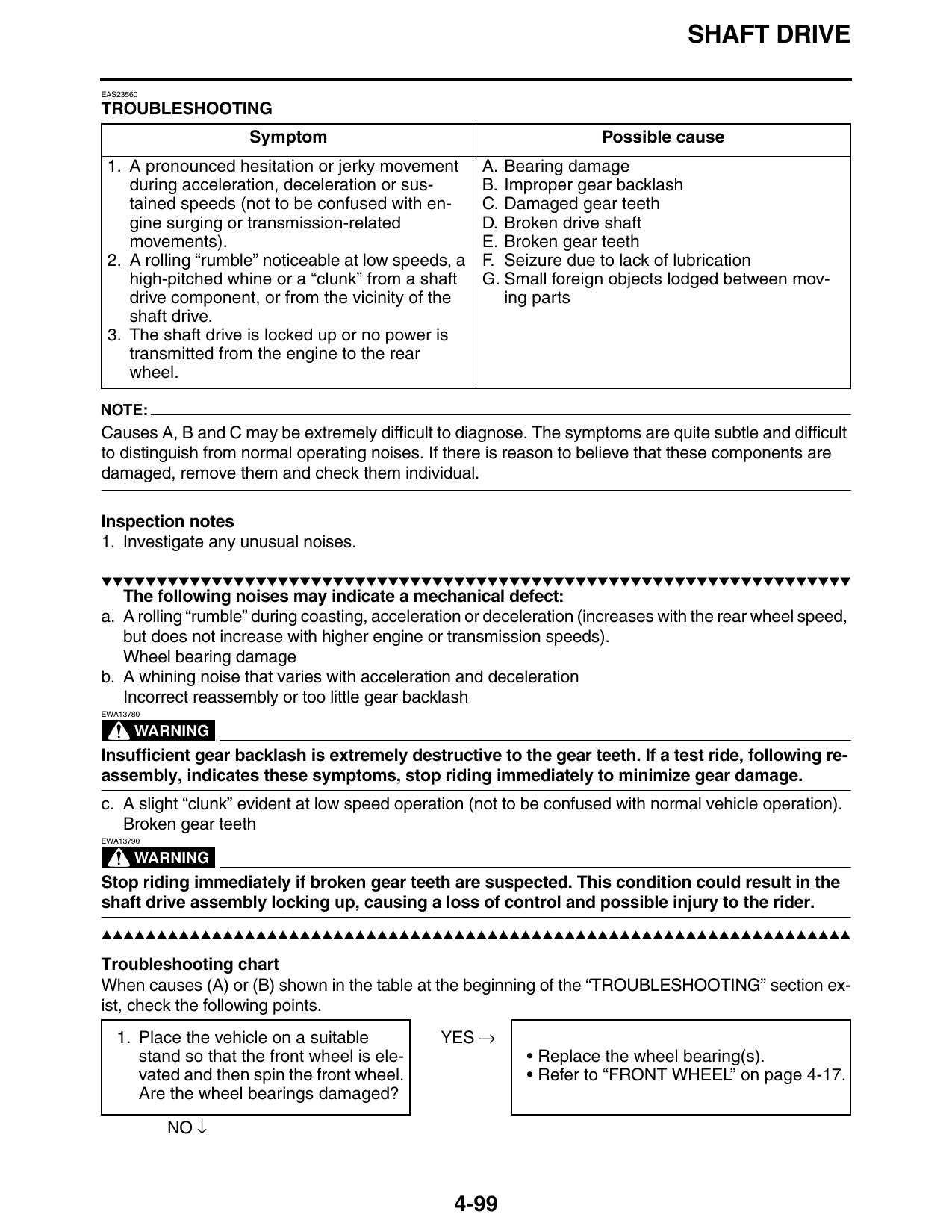
SHAFT DRIVE

EAS23560

TROUBLESHOOTING
                     Symptom                                          Possible cause
 1. A pronounced hesitation or jerky movement        A. Bearing damage
    during acceleration, deceleration or sus-        B. Improper gear backlash
    tained speeds (not to be confused with en-       C. Damaged gear teeth
    gine surging or transmission-related             D. Broken drive shaft
    movements).                                      E. Broken gear teeth
 2. A rolling “rumble” noticeable at low speeds, a   F. Seizure due to lack of lubrication
    high-pitched whine or a “clunk” from a shaft     G. Small foreign objects lodged between mov-
    drive component, or from the vicinity of the        ing parts
    shaft drive.
 3. The shaft drive is locked up or no power is
    transmitted from the engine to the rear
    wheel.

NOTE:
Causes A, B and C may be extremely difficult to diagnose. The symptoms are quite subtle and difficult
to distinguish from normal operating noises. If there is reason to believe that these components are
damaged, remove them and check them individual.

Inspection notes
1. Investigate any unusual noises.

▼▼▼▼▼▼▼▼▼▼▼▼▼▼▼▼▼▼▼▼▼▼▼▼▼▼▼▼▼▼▼▼▼▼▼▼▼▼▼▼▼▼▼▼▼▼▼▼▼▼▼▼▼▼▼▼▼▼▼▼▼▼▼▼▼▼▼▼
   The following noises may indicate a mechanical defect:
a. A rolling “rumble” during coasting, acceleration or deceleration (increases with the rear wheel speed,
   but does not increase with higher engine or transmission speeds).
   Wheel bearing damage
b. A whining noise that varies with acceleration and deceleration
   Incorrect reassembly or too little gear backlash
EWA13780

       WARNING
Insufficient gear backlash is extremely destructive to the gear teeth. If a test ride, following re-
assembly, indicates these symptoms, stop riding immediately to minimize gear damage.
c. A slight “clunk” evident at low speed operation (not to be confused with normal vehicle operation).
   Broken gear teeth
EWA13790

       WARNING
Stop riding immediately if broken gear teeth are suspected. This condition could result in the
shaft drive assembly locking up, causing a loss of control and possible injury to the rider.
▲▲▲▲▲▲▲▲▲▲▲▲▲▲▲▲▲▲▲▲▲▲▲▲▲▲▲▲▲▲▲▲▲▲▲▲▲▲▲▲▲▲▲▲▲▲▲▲▲▲▲▲▲▲▲▲▲▲▲▲▲▲▲▲▲▲▲▲

Troubleshooting chart
When causes (A) or (B) shown in the table at the beginning of the “TROUBLESHOOTING” section ex-
ist, check the following points.
   1. Place the vehicle on a suitable          YES →
      stand so that the front wheel is ele-                • Replace the wheel bearing(s).
      vated and then spin the front wheel.                 • Refer to “FRONT WHEEL” on page 4-17.
      Are the wheel bearings damaged?

           NO ↓

                                                 4-99