Checking And Charging The Battery
Fragment manuala — str. 689–691
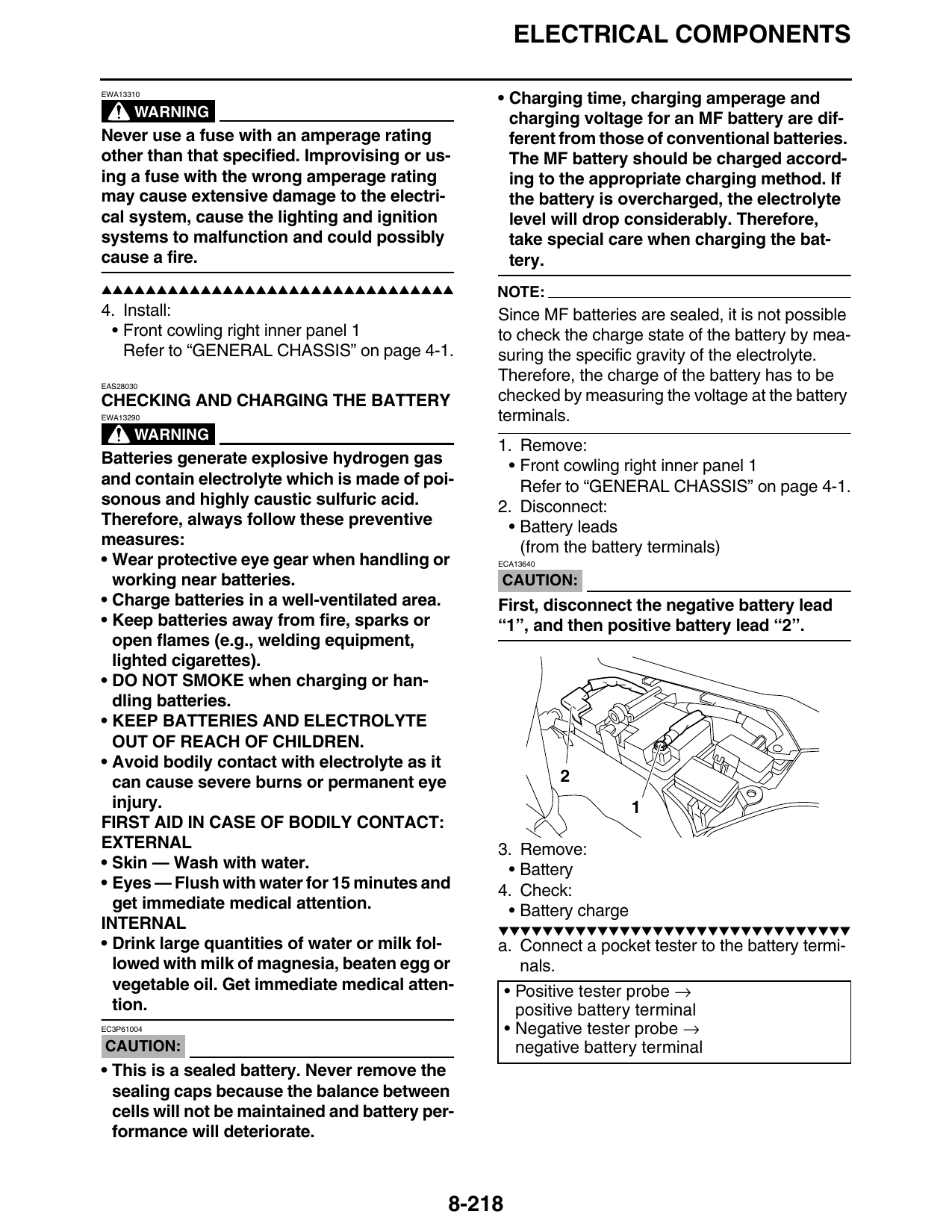
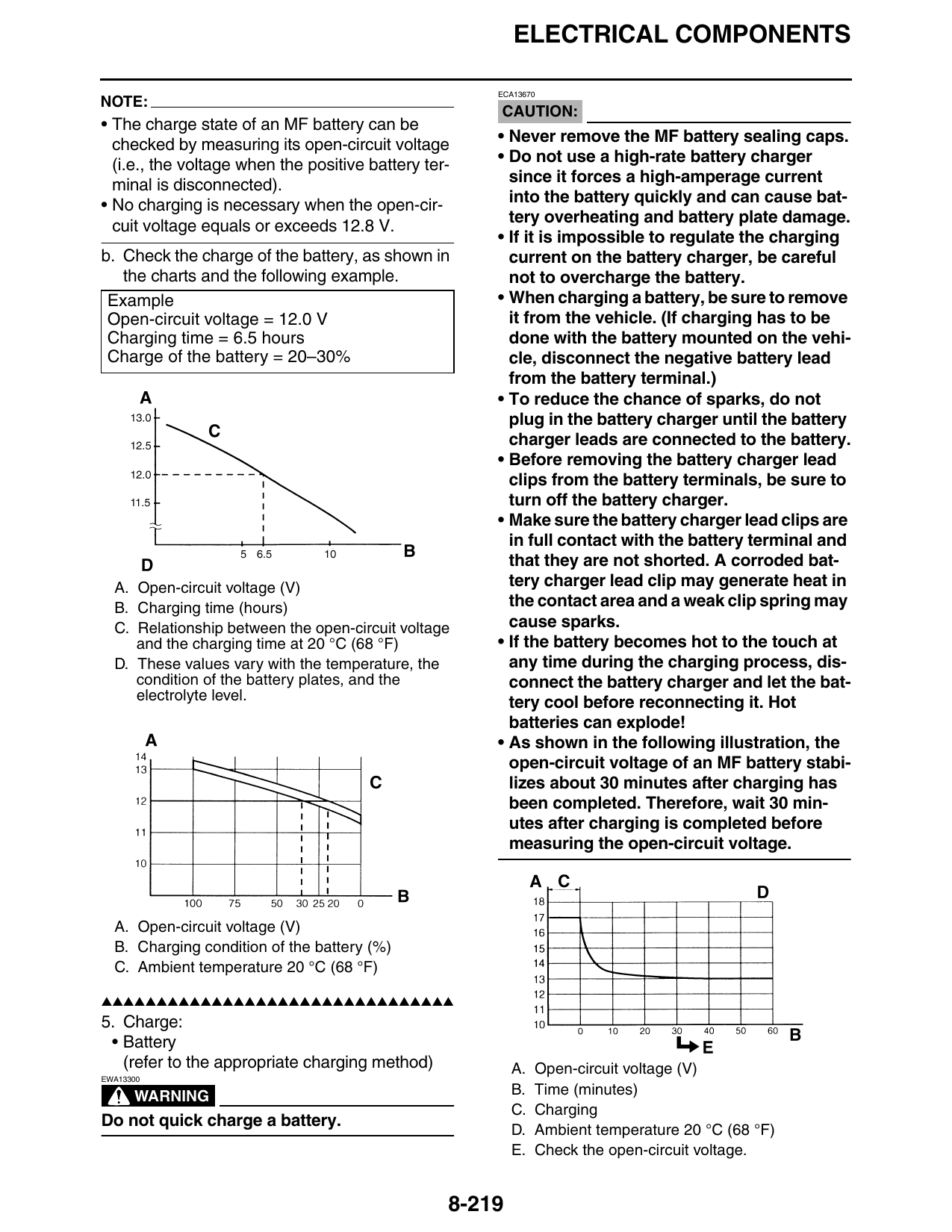
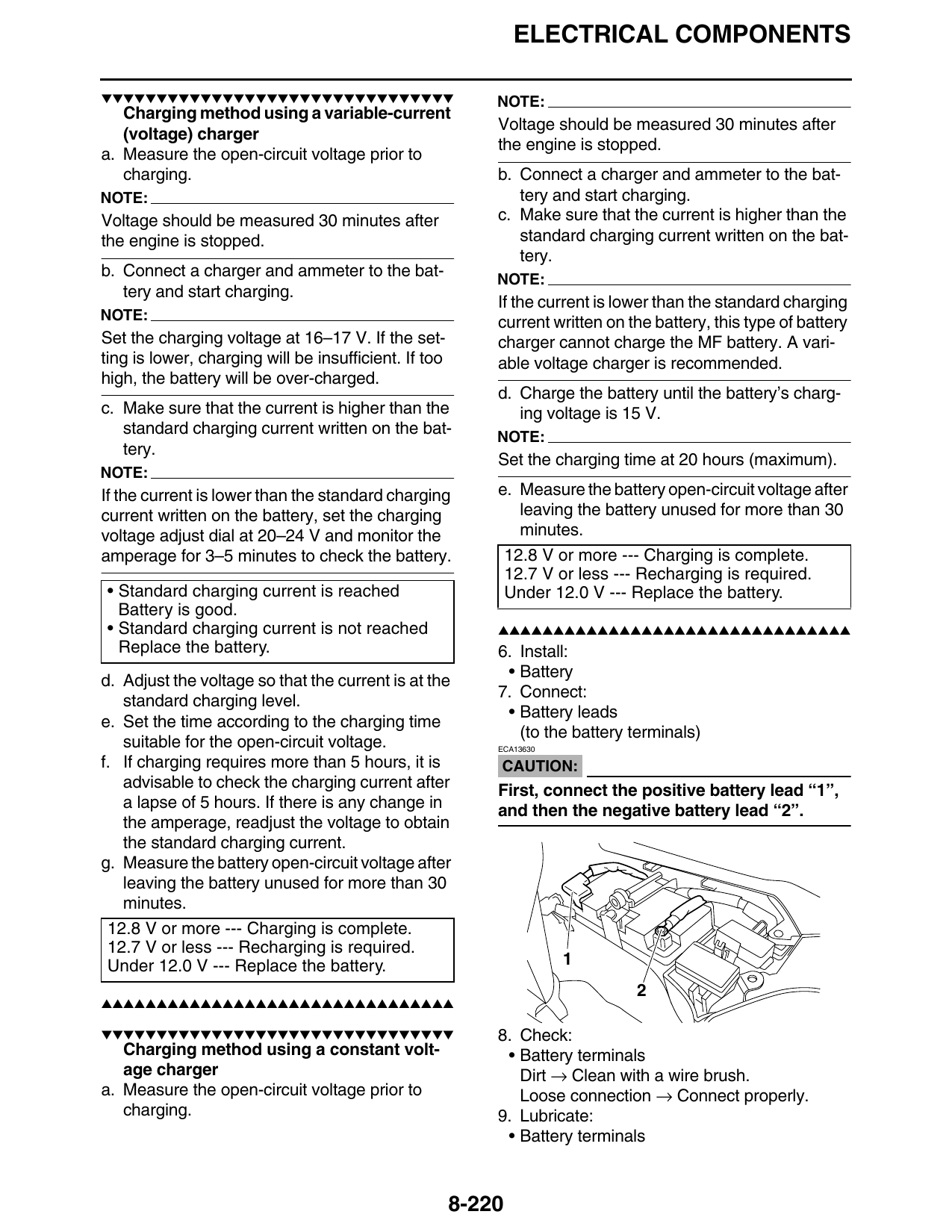
📋 Tekst do skopiowania / wyszukiwania
ELECTRICAL COMPONENTS

EWA13310
                                                  • Charging time, charging amperage and
       WARNING                                      charging voltage for an MF battery are dif-
Never use a fuse with an amperage rating            ferent from those of conventional batteries.
other than that specified. Improvising or us-       The MF battery should be charged accord-
ing a fuse with the wrong amperage rating           ing to the appropriate charging method. If
may cause extensive damage to the electri-          the battery is overcharged, the electrolyte
cal system, cause the lighting and ignition         level will drop considerably. Therefore,
systems to malfunction and could possibly           take special care when charging the bat-
cause a fire.                                       tery.
▲▲▲▲▲▲▲▲▲▲▲▲▲▲▲▲▲▲▲▲▲▲▲▲▲▲▲▲▲▲▲▲                  NOTE:
4. Install:                                       Since MF batteries are sealed, it is not possible
 • Front cowling right inner panel 1              to check the charge state of the battery by mea-
   Refer to “GENERAL CHASSIS” on page 4-1.        suring the specific gravity of the electrolyte.
EAS28030
                                                  Therefore, the charge of the battery has to be
CHECKING AND CHARGING THE BATTERY                 checked by measuring the voltage at the battery
EWA13290                                          terminals.
       WARNING
                                                  1. Remove:
Batteries generate explosive hydrogen gas          • Front cowling right inner panel 1
and contain electrolyte which is made of poi-        Refer to “GENERAL CHASSIS” on page 4-1.
sonous and highly caustic sulfuric acid.          2. Disconnect:
Therefore, always follow these preventive          • Battery leads
measures:                                            (from the battery terminals)
• Wear protective eye gear when handling or       ECA13640

  working near batteries.                         CAUTION:
• Charge batteries in a well-ventilated area.     First, disconnect the negative battery lead
• Keep batteries away from fire, sparks or        “1”, and then positive battery lead “2”.
  open flames (e.g., welding equipment,
  lighted cigarettes).
• DO NOT SMOKE when charging or han-
  dling batteries.
• KEEP BATTERIES AND ELECTROLYTE
  OUT OF REACH OF CHILDREN.
• Avoid bodily contact with electrolyte as it
  can cause severe burns or permanent eye                    2
  injury.                                                             1
FIRST AID IN CASE OF BODILY CONTACT:
EXTERNAL                                          3. Remove:
• Skin — Wash with water.                          • Battery
• Eyes — Flush with water for 15 minutes and      4. Check:
  get immediate medical attention.                 • Battery charge
INTERNAL                                          ▼▼▼▼▼▼▼▼▼▼▼▼▼▼▼▼▼▼▼▼▼▼▼▼▼▼▼▼▼▼▼▼
• Drink large quantities of water or milk fol-    a. Connect a pocket tester to the battery termi-
  lowed with milk of magnesia, beaten egg or          nals.
  vegetable oil. Get immediate medical atten-      • Positive tester probe →
  tion.                                              positive battery terminal
EC3P61004                                          • Negative tester probe →
CAUTION:                                             negative battery terminal
• This is a sealed battery. Never remove the
  sealing caps because the balance between
  cells will not be maintained and battery per-
  formance will deteriorate.

                                              8-218
                                                          ELECTRICAL COMPONENTS

                                                      ECA13670
NOTE:
                                                      CAUTION:
• The charge state of an MF battery can be
                                                      • Never remove the MF battery sealing caps.
  checked by measuring its open-circuit voltage
                                                      • Do not use a high-rate battery charger
  (i.e., the voltage when the positive battery ter-
                                                        since it forces a high-amperage current
  minal is disconnected).
                                                        into the battery quickly and can cause bat-
• No charging is necessary when the open-cir-
                                                        tery overheating and battery plate damage.
  cuit voltage equals or exceeds 12.8 V.
                                                      • If it is impossible to regulate the charging
b. Check the charge of the battery, as shown in         current on the battery charger, be careful
   the charts and the following example.                not to overcharge the battery.
 Example                                              • When charging a battery, be sure to remove
 Open-circuit voltage = 12.0 V                          it from the vehicle. (If charging has to be
 Charging time = 6.5 hours                              done with the battery mounted on the vehi-
 Charge of the battery = 20–30%                         cle, disconnect the negative battery lead
                                                        from the battery terminal.)
                                                      • To reduce the chance of sparks, do not
                                                        plug in the battery charger until the battery
                                                        charger leads are connected to the battery.
                                                      • Before removing the battery charger lead
                                                        clips from the battery terminals, be sure to
                                                        turn off the battery charger.
                                                      • Make sure the battery charger lead clips are
                                                        in full contact with the battery terminal and
                                                        that they are not shorted. A corroded bat-
  A. Open-circuit voltage (V)                           tery charger lead clip may generate heat in
  B. Charging time (hours)                              the contact area and a weak clip spring may
  C. Relationship between the open-circuit voltage      cause sparks.
     and the charging time at 20 °C (68 °F)           • If the battery becomes hot to the touch at
  D. These values vary with the temperature, the        any time during the charging process, dis-
     condition of the battery plates, and the           connect the battery charger and let the bat-
     electrolyte level.                                 tery cool before reconnecting it. Hot
                                                        batteries can explode!
                                                      • As shown in the following illustration, the
                                                        open-circuit voltage of an MF battery stabi-
                                                        lizes about 30 minutes after charging has
                                                        been completed. Therefore, wait 30 min-
                                                        utes after charging is completed before
                                                        measuring the open-circuit voltage.

  A. Open-circuit voltage (V)
  B. Charging condition of the battery (%)
  C. Ambient temperature 20 °C (68 °F)

▲▲▲▲▲▲▲▲▲▲▲▲▲▲▲▲▲▲▲▲▲▲▲▲▲▲▲▲▲▲▲▲
5. Charge:
 • Battery
   (refer to the appropriate charging method)             A. Open-circuit voltage (V)
EWA13300

      WARNING                                             B. Time (minutes)
                                                          C. Charging
Do not quick charge a battery.
                                                          D. Ambient temperature 20 °C (68 °F)
                                                          E. Check the open-circuit voltage.

                                                  8-219
                                                               ELECTRICAL COMPONENTS

▼▼▼▼▼▼▼▼▼▼▼▼▼▼▼▼▼▼▼▼▼▼▼▼▼▼▼▼▼▼▼▼                           NOTE:
   Charging method using a variable-current
                                                           Voltage should be measured 30 minutes after
   (voltage) charger
                                                           the engine is stopped.
a. Measure the open-circuit voltage prior to
   charging.                                               b. Connect a charger and ammeter to the bat-
NOTE:                                                         tery and start charging.
Voltage should be measured 30 minutes after                c. Make sure that the current is higher than the
the engine is stopped.                                        standard charging current written on the bat-
                                                              tery.
b. Connect a charger and ammeter to the bat-               NOTE:
   tery and start charging.
                                                           If the current is lower than the standard charging
NOTE:
                                                           current written on the battery, this type of battery
Set the charging voltage at 16–17 V. If the set-           charger cannot charge the MF battery. A vari-
ting is lower, charging will be insufficient. If too       able voltage charger is recommended.
high, the battery will be over-charged.
                                                           d. Charge the battery until the battery’s charg-
c. Make sure that the current is higher than the              ing voltage is 15 V.
   standard charging current written on the bat-           NOTE:
   tery.
                                                           Set the charging time at 20 hours (maximum).
NOTE:
If the current is lower than the standard charging         e. Measure the battery open-circuit voltage after
current written on the battery, set the charging              leaving the battery unused for more than 30
voltage adjust dial at 20–24 V and monitor the                minutes.
amperage for 3–5 minutes to check the battery.              12.8 V or more --- Charging is complete.
                                                            12.7 V or less --- Recharging is required.
• Standard charging current is reached                      Under 12.0 V --- Replace the battery.
  Battery is good.
• Standard charging current is not reached                 ▲▲▲▲▲▲▲▲▲▲▲▲▲▲▲▲▲▲▲▲▲▲▲▲▲▲▲▲▲▲▲▲
  Replace the battery.                                     6. Install:
                                                            • Battery
d. Adjust the voltage so that the current is at the
                                                           7. Connect:
   standard charging level.
                                                            • Battery leads
e. Set the time according to the charging time
                                                              (to the battery terminals)
   suitable for the open-circuit voltage.                  ECA13630

f. If charging requires more than 5 hours, it is           CAUTION:
   advisable to check the charging current after           First, connect the positive battery lead “1”,
   a lapse of 5 hours. If there is any change in           and then the negative battery lead “2”.
   the amperage, readjust the voltage to obtain
   the standard charging current.
g. Measure the battery open-circuit voltage after
   leaving the battery unused for more than 30
   minutes.
 12.8 V or more --- Charging is complete.
 12.7 V or less --- Recharging is required.
 Under 12.0 V --- Replace the battery.                                1
▲▲▲▲▲▲▲▲▲▲▲▲▲▲▲▲▲▲▲▲▲▲▲▲▲▲▲▲▲▲▲▲

▼▼▼▼▼▼▼▼▼▼▼▼▼▼▼▼▼▼▼▼▼▼▼▼▼▼▼▼▼▼▼▼                           8. Check:
   Charging method using a constant volt-                   • Battery terminals
   age charger                                                Dirt → Clean with a wire brush.
a. Measure the open-circuit voltage prior to                  Loose connection → Connect properly.
   charging.                                               9. Lubricate:
                                                            • Battery terminals

                                                       8-220